SHIRO & Co.
Climate Observatory / 2026
PRESS DEMONSTRATION
SHIRO & Co. Climate Observatory
Climate Temporal Compression is an experimental framework for observing how climate conditions can reduce the hours during which human and economic activity remain operationally usable.
PRESS DEMONSTRATION
This page presents a press demonstration of Climate Temporal Compression. For production use, enterprise assessment, or implementation inquiries, please contact SHIRO & Co.
Climate change is usually expressed through temperature. But human life and economic activity operate in time. When climate conditions narrow the periods during which outdoor work or other activities can realistically occur, the effect can be understood not only as rising temperature, but as a reduction in usable time.
SHIRO & Co. refers to this process as Climate Temporal Compression.
Temperature Change
Viable Conditions Shrink
Usable Time Shrinks
53-DAY COMPARISON
SHIRO & Co. applied the same experimental methodology to Kochi and Tokyo across 53 complete days from July 1 to August 22, 2026. The comparison uses hourly estimated WBGT data and asks a specific question: how much of a nominal outdoor workday remains experimentally usable under prevailing heat conditions?
KOCHI
Median usable-time loss: 1.0 hour
Maximum usable-time loss: 7.0 hours
Very-high heat constraint days: 28
Zero-loss days: 25
TOKYO
Median usable-time loss: 0.0 hours
Maximum usable-time loss: 7.0 hours
Very-high heat constraint days: 19
Zero-loss days: 34
Kochi
Tokyo
The scheduled workday had not changed. The usable workday had.
Temporal Geography
Temporal Geography describes the possibility that operational time itself acquires geography as climate exposure varies between locations.
ASSESSMENT VIEW
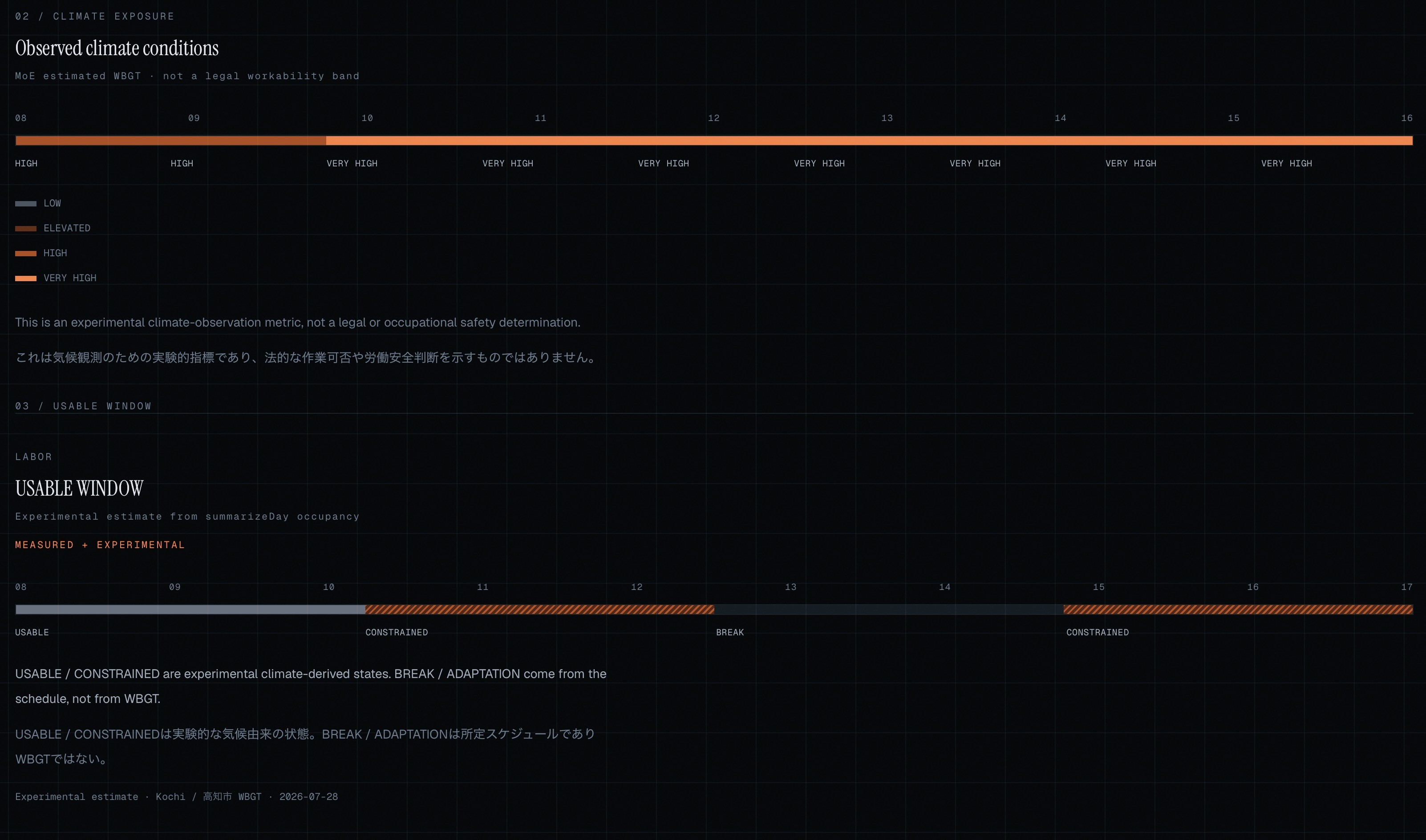
Climate Usable Time Assessment
Neutral placeholder for actual research screenshot. No interface image is fabricated on this page.
Experimental Climate Usable Time Assessment — Kochi / Tokyo. Observed climate conditions and experimental usable-time estimates are presented separately.
Kochi Prefecture has introduced a Cool Work Time guideline for public construction work that is primarily performed outdoors. During the summer period, the guideline calls in principle for work to stop between 11:00 and 14:00, with a sample operating schedule of 08:00–11:00 and 14:00–17:00. The guideline recognizes approximately two hours of shortened daily work and allows construction schedules to be extended accordingly.
This observed policy adaptation is separate from SHIRO & Co.’s experimental climate-derived usable-time estimate. This page does not imply endorsement by Kochi Prefecture.
SAMPLE OPERATING SCHEDULE
08:00–11:00
14:00–17:00
Organizations traditionally think about capacity through workforce, equipment, capital, and physical assets. Climate Temporal Compression introduces another possible variable: usable human time. If climatic conditions reduce the hours during which people can safely and realistically operate, regional execution capacity can begin to diverge even when staffing levels and nominal schedules remain unchanged.
Outdoor labor
Project scheduling
Workforce allocation
Regional capacity planning
Automation
Remote operations
Cooling infrastructure
Insurance and liability
Maintenance economics
A shortage of execution capacity does not always begin with a shortage of people. It can begin with a shortage of usable hours.
The scarce resource may not be the worker alone. It may be human time under viable climatic conditions.
Extreme Heat
Safe Work Window Shrinks
Usable Labor Time Declines
Project Duration Extends
Execution Capacity Changes
If daytime activity shifts into early morning, evening, or night, multiple systems may begin competing for the same remaining climatically viable hours: outdoor labor, public activity, human recovery, agriculture, and urban services.
Climate Temporal Compression
Temporal Scarcity
Time Competition
In a hotter climate, organizations may increasingly need to understand not only where workers, assets, and infrastructure are located, but when each location remains operationally usable. If this difference becomes economically material, access to climatically viable hours may need to be treated as part of operational infrastructure.
Time as Infrastructure
DATA SOURCE
Hourly estimated WBGT data published by Japan’s Ministry of the Environment.
OBSERVATION PERIOD
July 1 to August 22, 2026
LOCATIONS
Kochi / Tokyo
ASSESSMENT WINDOW
Standard daytime outdoor work period
Observed climate data and experimental interpretation are not the same thing. SHIRO & Co. uses observed WBGT data as input and applies an experimental framework to estimate usable-time loss.
This is an experimental climate-observation tool.
It does not determine legal workability, occupational safety compliance, individual heat risk, mandatory work suspension, or medical safety. WBGT is not presented here as a simple automatic stop-work rule.
Demonstration boundary
This public page presents the concept, observed inputs, selected findings, and interpretive framework of Climate Temporal Compression. Detailed production logic, enterprise implementation methods, and internal assessment processes are not presented on this press demonstration page.
This page presents a press demonstration of Climate Temporal Compression. For production use, enterprise assessment, or implementation inquiries, please contact SHIRO & Co.
About SHIRO & Co.
SHIRO & Co. is an independent research and design initiative that observes structural change across technology, society, markets, climate, and human behavior. Through the Kosuke Protocol, fragments and signals are developed into observations, structural patterns, simulations, and company-specific opportunities. On this page, that work is focused only on Climate Temporal Compression within the Climate Observatory.
Climate Temporal Compression is currently presented publicly as an experimental research and press demonstration. For production use, enterprise assessment, implementation discussions, or media inquiries, please contact SHIRO & Co.