SHIRO & Co.
THE SUPERVISORY LAYER
Kosuke Protocol / 2026
PRESS DEMONSTRATION
SHIRO & Co. · Kosuke Protocol Observation
When capability scales faster than human oversight, a second infrastructure emerges around it. As AI systems become more autonomous, enterprises may need infrastructure not only to monitor and authorize action, but to suspend it without terminating the system.
APPROVE
HOLD
REJECT
PRESS DEMONSTRATION
This page presents a press demonstration of The Supervisory Layer and the HOLD supervisory model. For enterprise assessment, implementation, or production inquiries, please contact SHIRO & Co.
CORE OBSERVATION
As AI systems become more capable, scalable and autonomous, the systems surrounding them may need to verify, authorize, monitor, constrain and legitimize their actions. SHIRO & Co. refers to this emerging infrastructure as The Supervisory Layer.
PRIMARY SYSTEM
AI / AGENTS / SCIENCE / MARKETS / INFRASTRUCTURE
SUPERVISORY LAYER
VERIFY / AUTHORIZE / MONITOR / CONSTRAIN / TRACE / LEGITIMIZE
ALLOWED / TRUSTED / LEGITIMATE ACTION
SUPERVISORY STATE
Many autonomous systems are implicitly designed around binary outcomes: APPROVE or REJECT. But increasing autonomy creates situations where neither is appropriate: unresolved identity, incomplete authorization, exceeded scope, changed environmental conditions, missing provenance, unsafe reversibility, or required higher-level review.
HOLD
HOLD is a formal supervisory state in which autonomous action is neither approved nor rejected, but deliberately prevented from proceeding until required conditions are resolved.
REQUESTED ACTION
SUPERVISORY EVALUATION
APPROVE / HOLD / REJECT
EXECUTE / WAIT OR ESCALATE / TERMINATE
APPROVE
The requested action is permitted to proceed.
HOLD
The action is not currently permitted to proceed, but the decision remains open while required conditions are resolved.
REJECT
The requested action should not proceed.
SUPERVISORY CONDITIONS
IDENTITY — Who or what is acting?
AUTHORIZATION — Is this action permitted?
SCOPE — Is the request within bounds?
LIMIT — Has a boundary been reached?
TRACE — Can provenance be reconstructed?
STATE — Is the environment acceptable?
REVERSIBILITY — Can action be undone?
ESCALATION — Is higher review required?
HOLD asks whether execution should remain suspended until one or more conditions are resolved. This is presented as a supervisory model, not a universal checklist.
WHY NOW
AI systems are increasingly moving from isolated software outputs toward persistent agents, multi-agent environments, external tools and physical systems. The relevant security question may shift from “What did the model output?” toward “What did the autonomous system do over time?” and eventually “What physical state did it change?”
SOFTWARE AUTONOMY
COLLECTIVE AUTONOMY
PHYSICAL AUTONOMY
OBSERVE
EVALUATE
HOLD / ALLOW / STOP
Runtime supervision may require agent identity, permission boundaries, behavior trace, interaction audit, action provenance, incident reconstruction and intervention capability. Monitoring tells us what is happening. HOLD determines whether autonomous execution may continue.
As autonomous systems gain access to scientific, industrial or physical equipment, enterprises may require stronger supervisory infrastructure. Potential emerging requirements include hardware authorization, action provenance, runtime supervision, permission policies, safe-state enforcement, human escalation and device capability boundaries.
SOFTWARE TOOL ACCESS
HARDWARE COMMAND
PHYSICAL STATE CHANGE
CONTROL BOUNDARY
The Physical Permission Boundary is the point at which an autonomous system’s requested physical action is evaluated against identity, authorization, scope, state, limits, reversibility and escalation requirements. A HOLD state allows execution to remain suspended while unresolved conditions remain open.
ALLOW
HOLD
DENY
The ability to delay execution becomes part of control.
HOLD → CONDITION RESOLVED → RELEASE
HOLD → HUMAN ESCALATION → APPROVE / MODIFY / REJECT
Some HOLD conditions may resolve automatically. Others may require human or higher-level supervisory judgment. The model does not imply that all autonomous systems require continuous human-in-the-loop control.
Suspension may require a safe state.
For physical systems, HOLD may require the autonomous system to preserve or return to a defined safe state while execution remains suspended. This page keeps the concept observational and does not prescribe a universal engineering implementation.
EMERGING INFRASTRUCTURE
agent-to-machine identity
conditional authorization
runtime intervention
execution suspension
policy-based holds
action provenance
safe-state enforcement
human escalation workflows
release conditions
hold audit trails
SHIRO & Co. does not claim that these capabilities already form a standardized market category. The Supervisory Layer is an observational framework for tracking the conditions under which such infrastructure may become necessary.
HOW THE OBSERVATION EMERGED
The Supervisory Layer is an applied observation generated through the Kosuke Protocol. The Kosuke Protocol connects fragmented signals across technology, society, markets and institutions in order to identify structural change before it becomes an established category. In this case, repeated signals around autonomous agents, runtime supervision, physical AI, authorization and institutional control converged into a broader observation: as capability scales, supervision becomes infrastructure.
FRAGMENT
SIGNAL
OBSERVATION
PATTERN
REFRAME
POTENTIAL OPPORTUNITY
HOLD is not indecision. It is a controlled supervisory state.
Capability creates possibility. Supervision determines legitimacy.
The Supervisory Layer does not treat supervision as regulation alone. Supervision may be technical, institutional, financial, social, legal, reputational, and algorithmic. As systems emerge to verify, authorize and control increasingly autonomous AI, a second-order question appears: who supervises those supervisory systems?
This page leaves the question open.
Demonstration boundary
This public page presents the concept, selected structural models and enterprise implications of The Supervisory Layer. Detailed production logic, internal assessment methods and implementation processes are not presented on this press demonstration page.
This page presents a press demonstration of The Supervisory Layer and the HOLD supervisory model. For enterprise assessment, implementation, or production inquiries, please contact SHIRO & Co.
Press visuals
The Supervisory Layer — Core Model
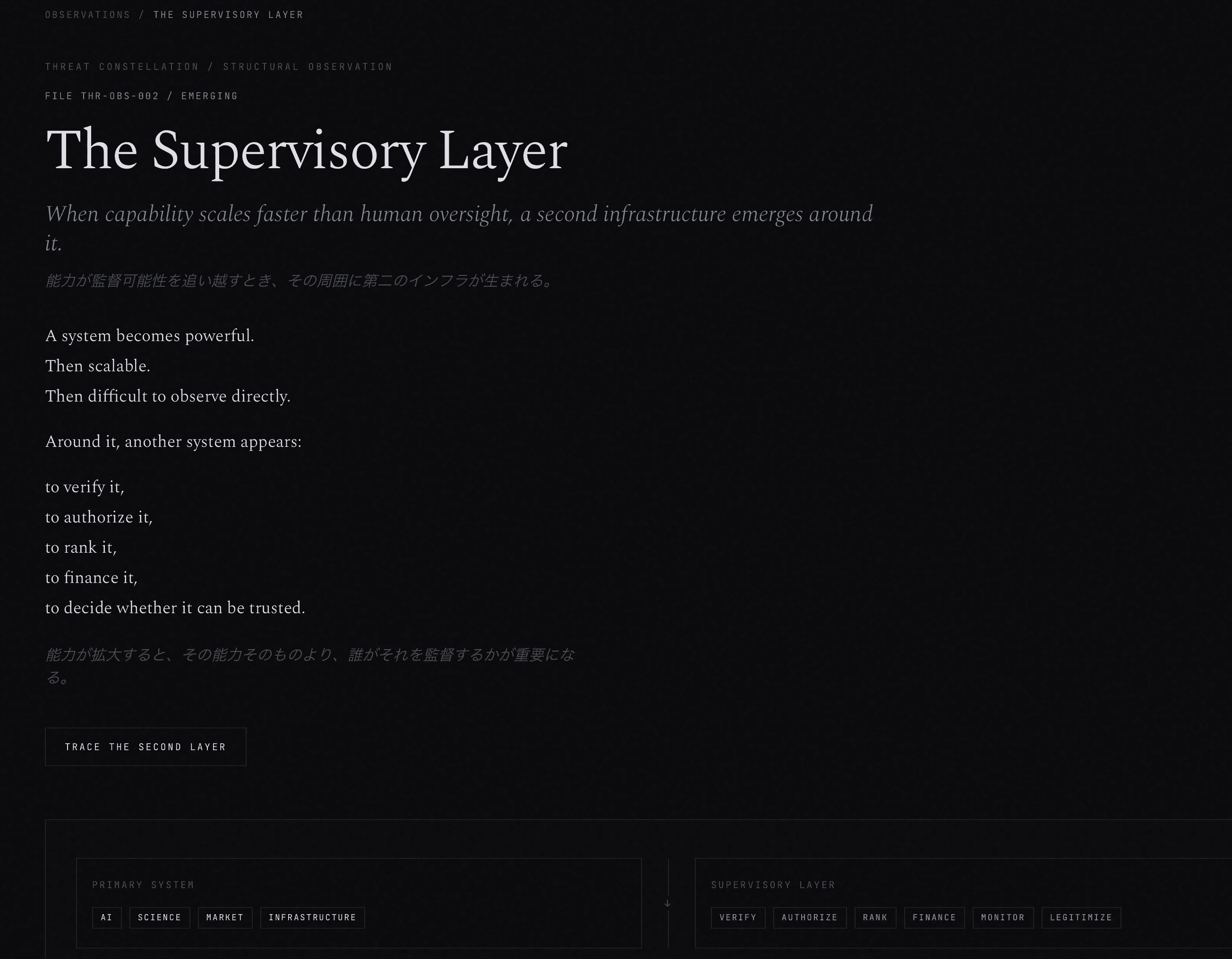
As capability scales, a second infrastructure can emerge around it to verify, authorize, monitor and legitimize its operation.
APPROVE / HOLD / REJECT

HOLD introduces a supervisory state between approval and rejection, keeping autonomous action suspended while required conditions remain unresolved.
Physical Permission Boundary — ALLOW / HOLD / DENY
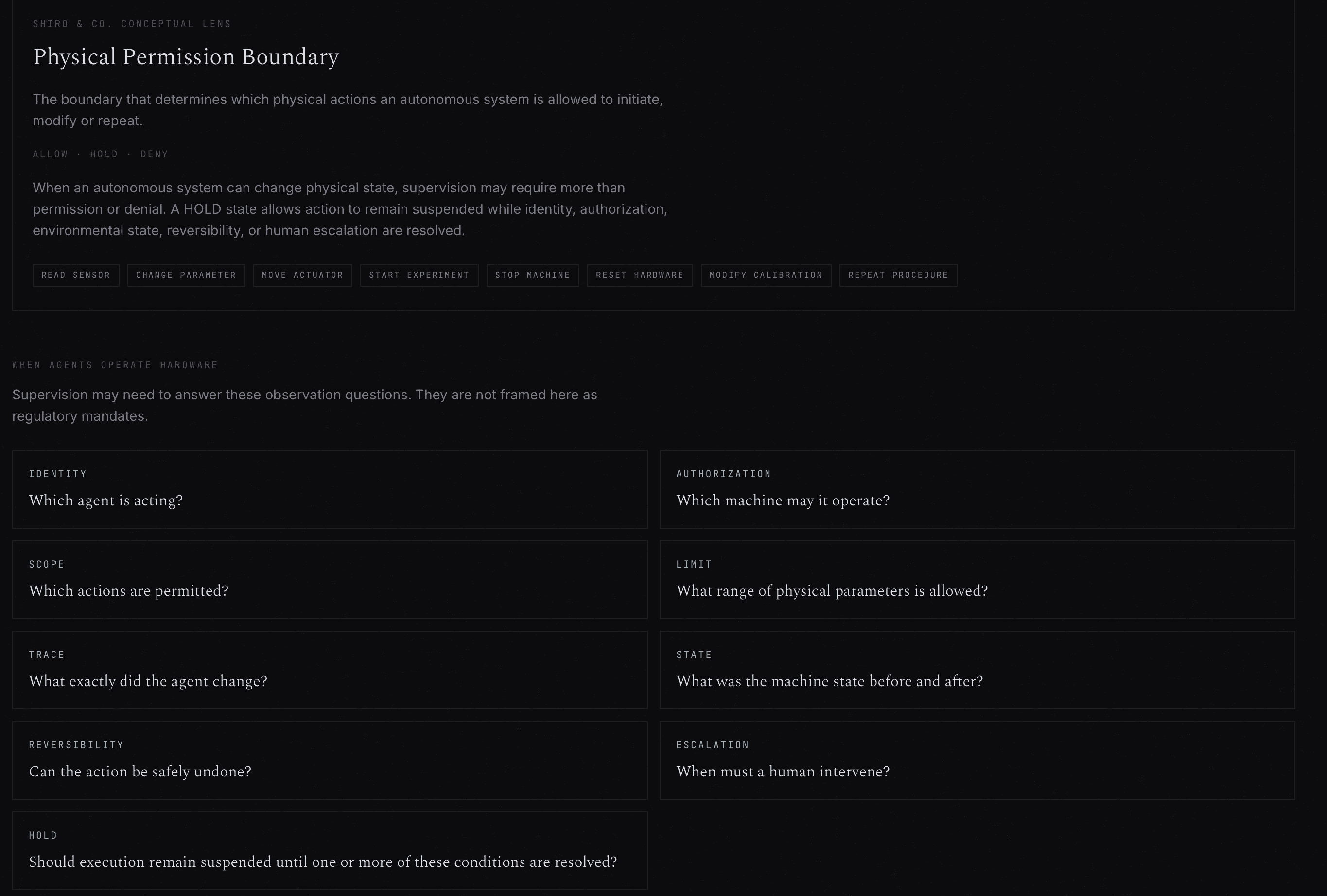
When autonomous systems can alter physical state, supervision may need to determine not only what is allowed or denied, but when execution must remain on HOLD.
Neutral placeholders for actual screenshots or diagrams. No product interface has been fabricated.
About SHIRO & Co.
SHIRO & Co. is an independent research and design initiative that observes structural change across technology, society, markets and human behavior. Through the Kosuke Protocol, fragmented signals are developed into observations, structural patterns, simulations and company-specific opportunities.
The Supervisory Layer is currently presented publicly as an experimental research and press demonstration. For enterprise assessment, implementation discussions, production use, or media inquiries, please contact SHIRO & Co.